
CrystalCore™ vs. Planar Magnetic vs. Electrostatic: A Driver Comparison
Three different answers to the same question — how do you move air with maximum precision?
Most audiophiles eventually start caring about driver technology. Not because the specs are interesting in the abstract, but because the driver is the single biggest determinant of how a headphone sounds — more than the housing, the pads, or the cable.
For most of audiophile history, there have been three credible answers to the question of how to move a diaphragm accurately: dynamic (moving coil), planar magnetic, and electrostatic. Each has a distinct engineering philosophy, a distinct set of strengths and limitations, and a devoted community of listeners.
The CrystalCore™ transducer is a fourth answer. To understand what makes it different, it helps to understand what the other three are doing — and where each one runs into its limits.
Dynamic (Moving Coil): The Workhorse
Dynamic drivers are what you'll find in the vast majority of headphones at every price point. A voice coil is attached to a cone or dome-shaped diaphragm. Current flows through the coil, which interacts with a permanent magnet, causing the diaphragm to move and create sound.
What they do well: Full-range sound, robust low-frequency extension, relatively easy to drive. Excellent designs at every price point. Durable and practical.
Where they run into limits: The voice coil adds mass to the moving system. That mass creates inertia — the diaphragm is slower to start moving and slower to stop. At high frequencies and fast transients, this inertia causes smearing: fine details get slightly blurred at the edges. High-quality dynamic designs mitigate this with lighter materials and tighter tolerances, but the fundamental physics don't change.
Representative headphones: Sennheiser HD800S, Focal Utopia, Beyerdynamic T1.
Planar Magnetic: The Flat-Panel Alternative
Planar magnetic drivers replace the cone-and-coil arrangement with a thin membrane — often measured in microns — suspended between two sets of magnets. A conductive trace is embedded directly into the membrane. When current flows through the trace, the magnetic field causes the entire membrane surface to move uniformly.
What they do well: Because the driving force is distributed across the whole membrane rather than concentrated at the center (as in a dynamic driver), planars tend to exhibit lower distortion and more even excursion. Detail retrieval is typically strong. Bass can be excellent.
Where they run into limits: The membrane is thin but it still has mass, and the driving force from the magnetic array has to overcome it. Planar headphones are also notoriously power-hungry — those magnets need current to work effectively. High-end planars can approach electrostatic performance in detail resolution, but they still face physical constraints on transient speed.
Representative headphones: HiFiMan Arya, Audeze LCD-4, Dan Clark Audio Stealth, Meze Empyrean.
Electrostatic: The Speed Benchmark
Electrostatic drivers work on a fundamentally different principle. A very thin, extremely light membrane is suspended between two perforated electrodes (stators). A high-voltage bias charge is applied to the membrane. The audio signal modulates the voltage on the stators, and the electrostatic force pulls the membrane toward whichever stator is more positively charged.
Because the membrane has almost no mass — we're talking substrates thinner than a human hair — it responds to electrical signals almost instantaneously. The result is transient speed and micro-detail retrieval that no conventional dynamic or planar design can match.
What they do well: Exceptional speed, low distortion, extraordinary resolution of fine detail. The "electrostatic sound" — airy, effortlessly detailed, crystalline — is real and distinctive.
Where they run into limits: The high-voltage bias requirement means you need a dedicated energizer/amplifier, typically expensive and large. Bass extension is often a weakness — the very thinness and lightness of the membrane that makes it fast also limits how much air it can displace in the low frequencies. Sub-bass in particular can feel ethereal rather than physical. Fragility is also a real concern; thin membranes are vulnerable to humidity, dust, and physical damage.
Representative headphones: Stax SR-009S, Hifiman Shangri-La, Audeze CRBN.
CrystalCore™: The Piezoelectric Fourth Path
The CrystalCore™ transducer starts from a different question entirely: what if the diaphragm itself were the driver?
In a piezoelectric design, a crystalline composite material physically deforms when voltage is applied across it. There is no separate magnet, no voice coil, no electrostatic bias charge. The material and the diaphragm are functionally one. When the audio signal changes, the material responds — directly, with near-zero mechanical delay.
Transient speed: Because there is no separate driving mechanism with its own mass and inertia, the CrystalCore™ driver responds to the electrical signal with a speed that rivals electrostatic designs. The micro-detail and transient accuracy that electrostatics are famous for is achievable without the trade-offs of ultra-thin membranes.
Bass capability: Unlike electrostatic designs, the CrystalCore™ driver uses a large (75mm in Genesis One) flat-panel diaphragm that can displace significant air. This is what makes genuine sub-bass extension in an open-back design possible — something that electrostatics typically cannot achieve.
Amplifier requirements: Like electrostatics, the CrystalCore™ driver has an unusual electrical character — it behaves as a capacitive load and requires 10–20 Vrms of voltage swing rather than raw wattage. This is a meaningful requirement, but it's achievable with quality desktop amplification and a growing range of tube and solid-state designs.
Where it's still developing: CrystalCore™ technology is new. The engineering challenges of tuning a piezoelectric driver for full-range audiophile performance — particularly smoothing modal resonances and achieving consistent channel matching — are non-trivial. We've solved them in Genesis One, but it required two years of intensive development and iteration.
How They Compare at a Glance
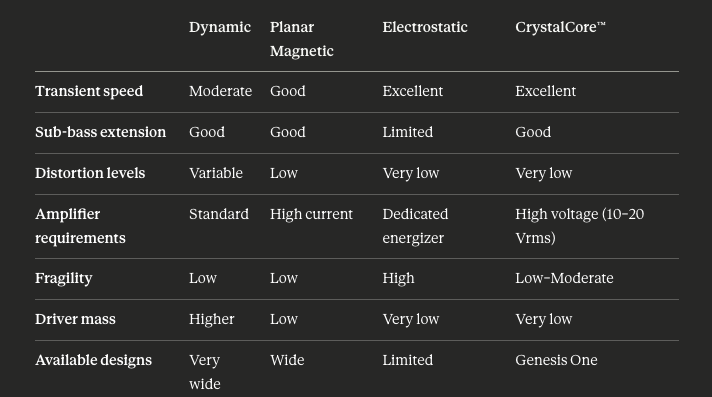
No single driver architecture does everything perfectly. Dynamic headphones remain the most practical and versatile. Planar magnetics offer an excellent balance of performance and drivability. Electrostatics remain the reference for pure speed and resolution.
CrystalCore™ is an attempt to capture what makes electrostatics special — the speed, the micro-detail, the absence of mechanical inertia — while addressing the limitations that have kept them from being the only answer: sub-bass capability, durability, and long-term usability in real-world listening environments.
Whether we've succeeded is for you to decide.
You can read more about the CrystalCore™ transducer on our technology page, or find Genesis One at lilyaudio.com/genesis-one.