
When Innovation Becomes Sound: The Shared Tech in a Bugatti Tourbillon and Genesis One
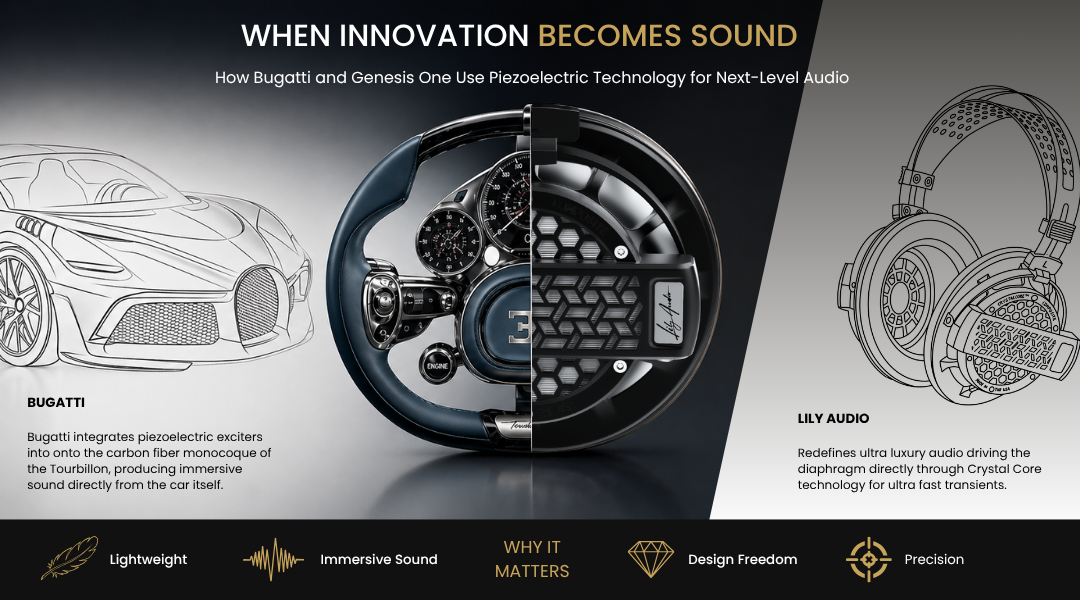
At first glance, a reference-grade headphone and a multi-million-dollar hypercar should have nothing in common. One lives in the listening room. The other on the road. But beneath the leather, aluminum, and carbon fiber, both may be relying on the same quietly radical idea:
Use crystal to make surfaces sing.
That’s the principle behind piezoelectric technology. Apply voltage to a piezo material, and it physically flexes. Flex it fast enough (we’re talking thousands of times per second) and it creates pressure waves we hear as sound. Attach that piezo actuator to a surface, and the surface itself becomes the speaker. No conventional cone. No voice coil. No heavy moving mass. Just controlled vibration turning structure into sound.
Piezoelectric technology is moving beyond the margins and beginning to be seen as one of the more disruptive ideas in audio. And not just in headphones. The Bugatti Tourbillon offers a premium example, using piezo-based exciters to turn portions of the vehicle’s structure into a sound-radiating surface. The car itself becomes part of the speaker.
That’s not a gimmick. It’s an engineering philosophy.
And it’s the same philosophy behind crystal-core headphone design.
In a traditional driver, a diaphragm is pushed by magnets and coils. In a crystal composite driver, the active material itself becomes the driver. It responds extraordinarily fast to electrical signals, which can mean sharper transient response, lower distortion, and more of the tiny spatial cues audiophiles chase. Because the mechanism is lighter and more direct, you’re not fighting the inertia of older architectures in the same way.
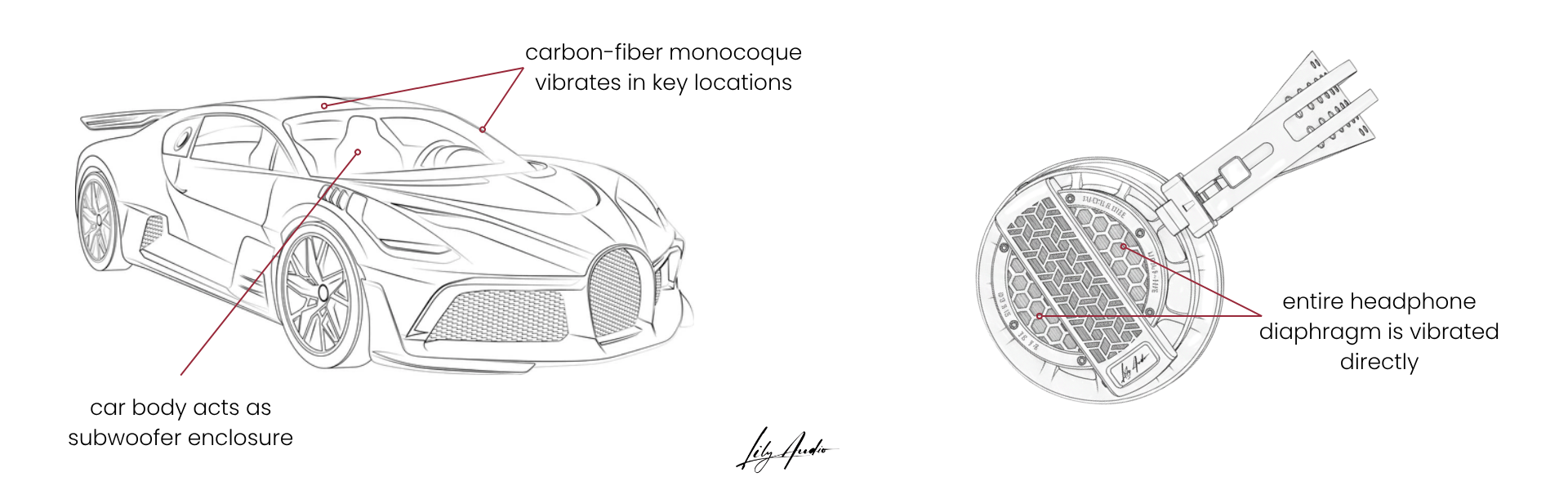
Bugatti uses that precision to make a machine feel alive in places the engine cannot.
We use it to make recordings feel alive.
So if a Tourbillon feels a little out of reach, why not try out a pair of Genesis One headphones… they’ve got some shared DNA after all.