
Genesis One: KS Update #7
12/20/2025
1. Mini build
Over the past week, we gathered parts for the latest (and final) iteration and built two units. The goal was to check fit, manufacturability, and acoustic performance.
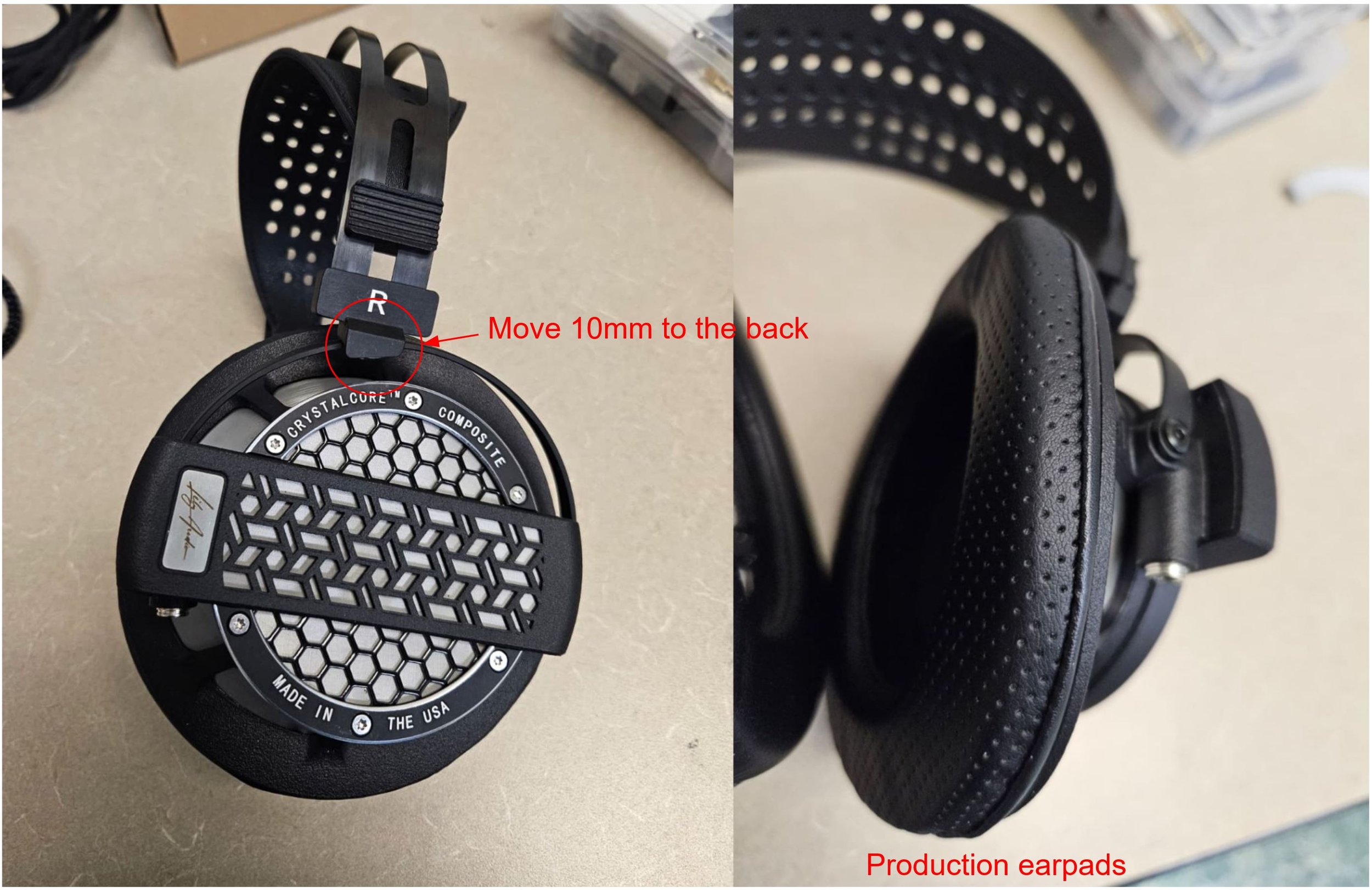
As shown in the attached photos, the design changes are mostly minor. The most noticeable update is that the pivot / vertical hinge on the frame has been moved backward by about 10 mm. This adjustment helps distribute pressure on the earpads more evenly between the front and back, resulting in a more balanced feel and improved long-term comfort.
The builds went smoothly, so we’re moving ahead with ordering parts in higher quantities and preparing for production starting next week.
2. Tuning
First of all, a big thank you to Andrew (rusticstands71) and Lachlan (Passion for Sound) for taking the time to share their honest and thoughtful reviews of the Genesis One prototype (EV3, the same version sent to Audiophile Heaven and Oratory). Their feedback has been incredibly helpful, and it closely matched what we were seeing in both earlier feedback and measurement data.
The main takeaway was that the midrange was slightly recessed, which made the treble feel too prominent, even though the overall balance was supported by strong bass. In measurements, the difference between the treble and the midrange was about 20 dB, which is significantly higher than most well-known headphone target curves (typically around 12–15 dB).
Since then, we’ve been focused on reducing that gap. We’ve made solid progress by introducing a custom perforated hybrid earpad. Compared to the velour earpads used in the previous iteration, this new pad is less porous and slightly thinner. As shown in the attached measurements, the perforated earpad boosts the bass and midrange while gently reducing the treble at the same time.
The result is a tuning that still has a U-shaped character, but is much flatter and more balanced than before. The difference between the treble and the midrange is now around 13 dB, and the sub-bass extends cleanly down to roughly 30 Hz. Overall, this is well aligned with commonly preferred frequency response targets.
We’re continuing to test additional custom earpads, and moving forward, every Genesis One will include two different pairs of earpads, each with a slightly different tuning, one of them a bit warmer than the other, so you can choose what suits you best. We may also offer one or two additional earpad options on our website for those who want to experiment further.
Next, we’ll be working on improving the smoothness of the frequency response in the 600 Hz–1 kHz region over the coming days.
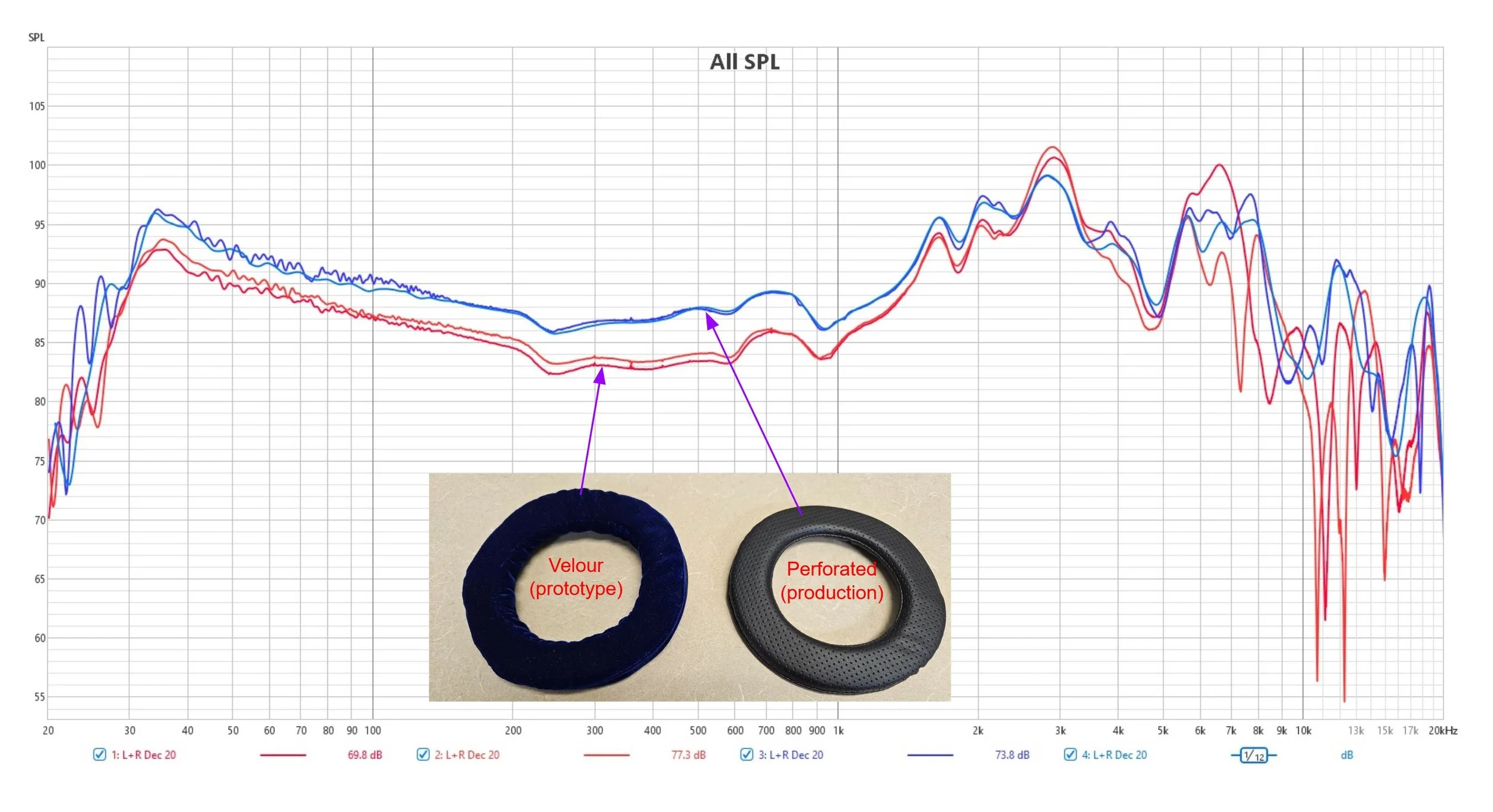
Genesis One updated tuning - Raw data.
3. Amplifier
The great news is that sensitivity has also improved with the updated tuning as seen in the above frequency response curve. Overall, sensitivity is up by about 4–5 dB, bringing Genesis One to approximately 75 dB / Vrms.
We’ve received quite a few questions about amplifier pairing, so I wanted to address them here and open the discussion.
3.1. What amplifiers can drive Genesis One?
With the exception of some poorly designed low-cost Class D and tube amplifiers, most amplifiers are technically capable of driving Genesis One. The main question isn’t whether an amp can drive it, but how loud it can get.
To estimate whether an amplifier will meet your listening needs, we strongly recommend checking Oratory’s measurement results and amplifier recommendations (link). His data shows exactly what sound pressure levels different amplifiers can achieve.
General rule of thumb:
10V → low-medium listening levels
20V → medium-loud listening levels
30V → loud-very loud listening levels
Personally, in a quiet room, a 10 V amplifier works well for me.
3.2. Can Genesis One sensitivity be expressed as dB/mW?
This is a great question and one we’ve been asked often.
In theory, converting from dB/V to dB/mW is straightforward only if the driver is a purely resistive load. Genesis One’s driver, however, behaves almost like a capacitor rather than a resistor. Theoretically, a pure capacitor consumes zero power; in practice, our driver behaves more like an RC circuit.
To estimate power consumption in milliwatts, we connected the driver to a small series resistor, then used an oscilloscope to measure the phase difference between current and voltage across the driver. From there, we calculated power using:
P = V × I × cos(φ)
This is how we arrived at an estimated sensitivity of 102 dB/mW. That said, we’re very open to feedback here — if this approach isn’t correct or if there’s a better or more straightforward method, we’d genuinely appreciate hearing your thoughts.
In practical use, however, dB/V is the more relevant metric for Genesis One, since it primarily requires a higher voltage swing to reach higher listening levels.
Tube amplifier testing
Lastly, BIA has kindly shipped one of their tube amplifiers for us to test. Thank you so much for the support! We’ll be spending time with it over the next few days and will report back with our impressions.
Warm regards,
Tony.